
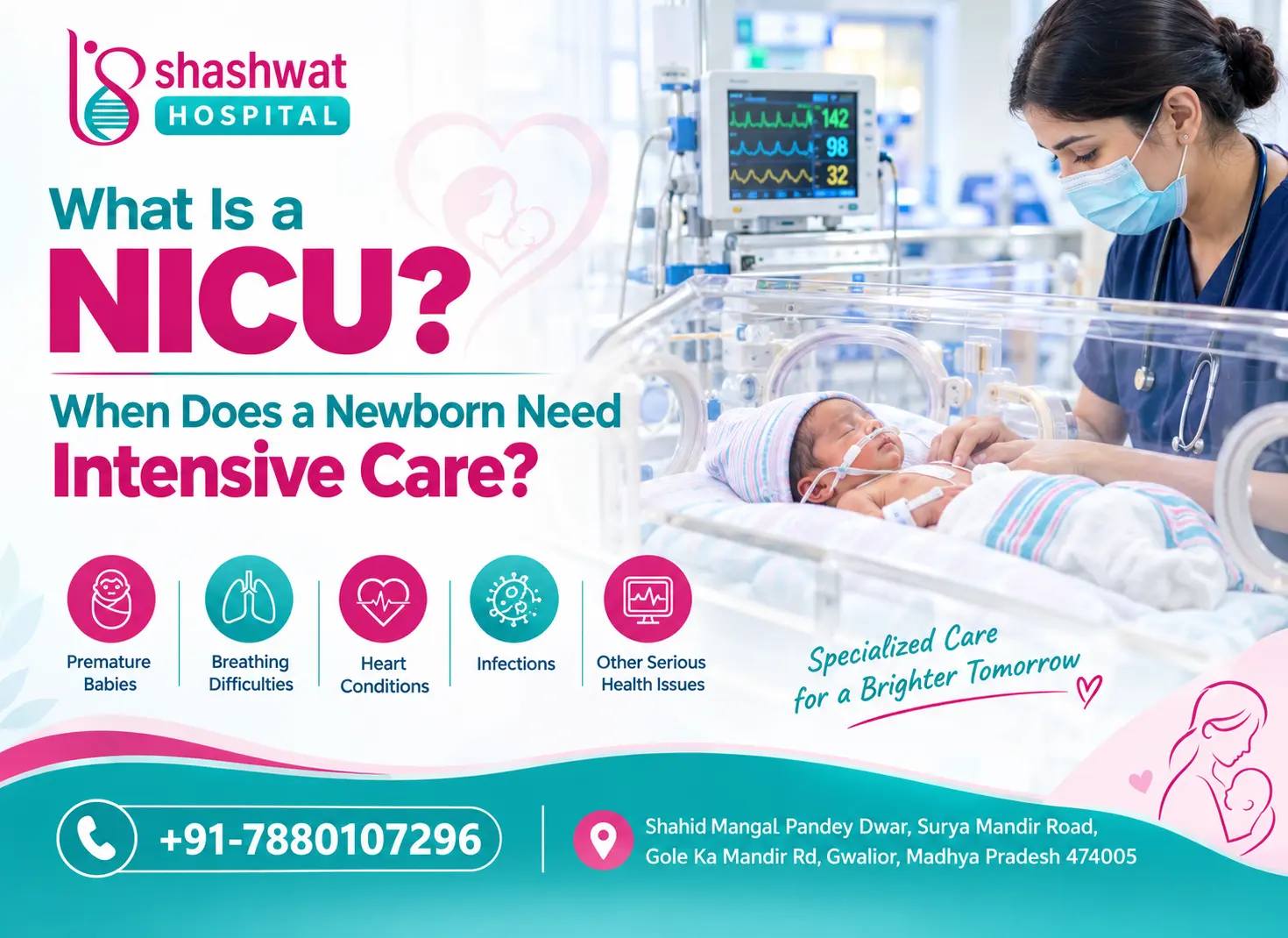
What is a NICU? A NICU, or neonatal intensive care unit, is a special hospital unit that gives round-the-clock care to newborns who are born too early, too small, or too unwell to stay in a normal ward. A baby needs NICU admission when they struggle to breathe, feed, stay warm, or fight infection on their own.
If you are expecting a baby or worried about a newborn, knowing this early helps you act faster. This guide explains how a NICU works, which babies need it, and what to look for in a top hospital with NICU care. It comes from Shashwat Hospital, Gwalior.
What Is a NICU? Meaning, Purpose and Levels of Care
A NICU is a ward built for the smallest and most fragile patients. It has specialised machines, constant monitoring, and a trained team of neonatologists (newborn specialists), nurses, and support staff.
The goal is simple: give a sick or premature baby the support their body is not yet ready to provide. That may mean breathing help, controlled warmth, special feeding, or treatment for infection.
Not every newborn unit offers the same care. The American Academy of Pediatrics groups newborn care into levels, from basic nurseries to units that treat the most critical babies. Before delivery, ask which level of care your hospital can provide.
When Does a Newborn Need Intensive Care?

Most babies go home with their mother. Some need extra support right after birth, and the signs are usually clear to the medical team.
Common reasons for NICU admission include:
- Premature birth: born before 37 weeks of pregnancy, according to the World Health Organization (WHO).
- Low birth weight: weighing less than 2.5 kg at birth.
- Breathing problems: the lungs are not fully developed or the baby cannot breathe well.
- Infection: a serious infection in the blood or lungs.
- Birth asphyxia: the baby did not get enough oxygen around the time of birth.
- Severe jaundice: yellow skin from high bilirubin that needs light therapy.
- Birth defects: problems with the heart, gut or other organs that need quick assessment or surgery.
- Maternal health issues: conditions like diabetes or high blood pressure, or multiple births such as twins.
Here is how the NICU helps in each case:
| Condition | What It Means | How the NICU Helps |
| Premature birth | Organs are not fully ready | Warmth, oxygen, tube feeding, close monitoring |
| Breathing difficulty | Lungs cannot supply enough oxygen | CPAP or ventilator support |
| Severe jaundice | Too much bilirubin in the blood | Phototherapy (special light treatment) |
| Infection | Germs spreading in a weak body | Blood tests, IV antibiotics, observation |
| Low blood sugar | Baby cannot keep energy levels steady | Glucose monitoring, IV or tube feeds |
Warning Signs a Newborn May Need Urgent Care
Most NICU decisions happen at birth. But some babies show warning signs in the first days or weeks at home. Treat these as an emergency and see a doctor straight away:
- Fast, noisy or laboured breathing, or the chest pulling in with each breath
- Blue or grey lips, tongue or skin
- Refusing feeds or feeding very poorly
- Unusual sleepiness, floppiness or a weak cry
- Fever, or a body that feels very cold
- Yellow skin spreading to the belly and legs
- Repeated vomiting, or stiffening and jerking movements
Inside an Advanced NICU Facility: Equipment and Care
A good unit looks very different from a regular ward. An advanced NICU facility works like a safe, controlled space that copies the womb as closely as possible.
Key equipment includes:
- Incubators and warmers: keep the baby’s body temperature steady.
- Ventilators and CPAP machines: support breathing when the lungs are weak.
- Monitors: track heart rate, breathing and oxygen levels every second.
- Phototherapy lights: break down excess bilirubin to treat jaundice.
- Infusion pumps: deliver fluids, nutrition and medicines in tiny, exact doses.
Equipment alone is not enough. A neonatologist and trained nurses must be available around the clock to read the monitors and act quickly. Learn more about our Pediatrics & Neonatology services.
How Long Does a Baby Stay in the NICU?
There is no fixed answer. A baby with mild breathing trouble or jaundice may stay for a few days. A very premature baby may need several weeks.
Doctors usually discharge a baby when they can breathe without help, feed well, gain weight and keep their own body temperature. For premature babies, this often happens close to the original due date. Your care team will update you often and explain what to expect.
How Parents Can Support a Baby in the NICU
Parents are part of the care team, not just visitors. Small actions make a real difference.
- Practise kangaroo mother care: skin-to-skin contact on the mother’s chest. WHO recommends it for small and premature babies.
- Give breast milk: if possible, express milk. It protects against infection and helps growth.
- Wash hands properly: infection control is critical in a NICU.
- Ask questions: a good team will explain every treatment in simple words.
- Look after yourself: rest, eat well, and accept help from family.
How to Choose the Best NICU Hospital in Gwalior
When labour starts, there is little time to compare hospitals. Searching “NICU hospital near me” at that moment is stressful. It is far safer to choose before delivery, especially if your pregnancy is high risk.
Use this checklist to judge the best NICU hospital in Gwalior for your family:
- A neonatologist or paediatrician available 24/7
- Ventilator, CPAP and phototherapy in the same hospital
- Gynaecology and newborn care under one roof, so mother and baby stay close
- Clear infection control rules
- A plan for emergency transfer if your baby needs higher-level care
- Clear costs and cashless insurance options
Our “5-Question Readiness Check” for expecting parents. Before your due date, ask the hospital these five questions:
- Is a newborn specialist on call at night?
- Can you treat breathing problems here, without transfer?
- Where will my baby stay if admitted?
- How often will we receive updates?
- What will the NICU cost, and is insurance accepted?
If a hospital answers all five clearly, you can plan with more confidence.
NICU Care at Shashwat Hospital, Gwalior
Shashwat Hospital has a dedicated NICU and PICU with advanced life-support systems and trained specialists. Our team handles critical newborn and child cases around the clock. We aim to be a top hospital with NICU care that families in Gwalior and nearby areas can trust.
Mother and baby care sit together. Our gynaecology and obstetrics team works alongside our newborn specialists, so help is close if your baby needs it. Read about our Gynae & Obstetrics services.
Summary
A NICU is a specialised unit that gives round-the-clock care to premature, low-weight or sick newborns. Admission is common and often temporary. Many babies who need NICU care grow up healthy.
Choose your hospital early, know the warning signs and ask the right questions. Early action gives your baby the best start.
Frequently Asked Questions
1. Why would a baby be sent to the NICU?
A baby goes to the NICU when they need more care than a normal nursery can give. Common reasons include premature birth, low birth weight, breathing trouble, infection, severe jaundice and birth defects. The NICU gives close monitoring and treatment until the baby is stable.
2. How long does a baby stay in the NICU?
The stay depends on the baby’s condition. It may be a few days for mild problems or several weeks for very premature babies. Doctors discharge a baby once they can breathe, feed and keep warm on their own.
3. Can parents touch or hold their baby in the NICU?
In most cases, yes. Parents are encouraged to touch, talk to and hold their baby, often through skin-to-skin kangaroo care. The team will guide you on when and how, based on your baby’s condition.
Book a NICU Consultation at Shashwat Hospital
Do you have a high-risk pregnancy, or are you worried about your newborn? Do not wait for an emergency. Talk to our team about your baby’s care.
Call us at +91-7880107296 or Book an Appointment today.
Visit Shashwat Hospital, Surya Mandir Road, Gole Ka Mandir, Gwalior.